
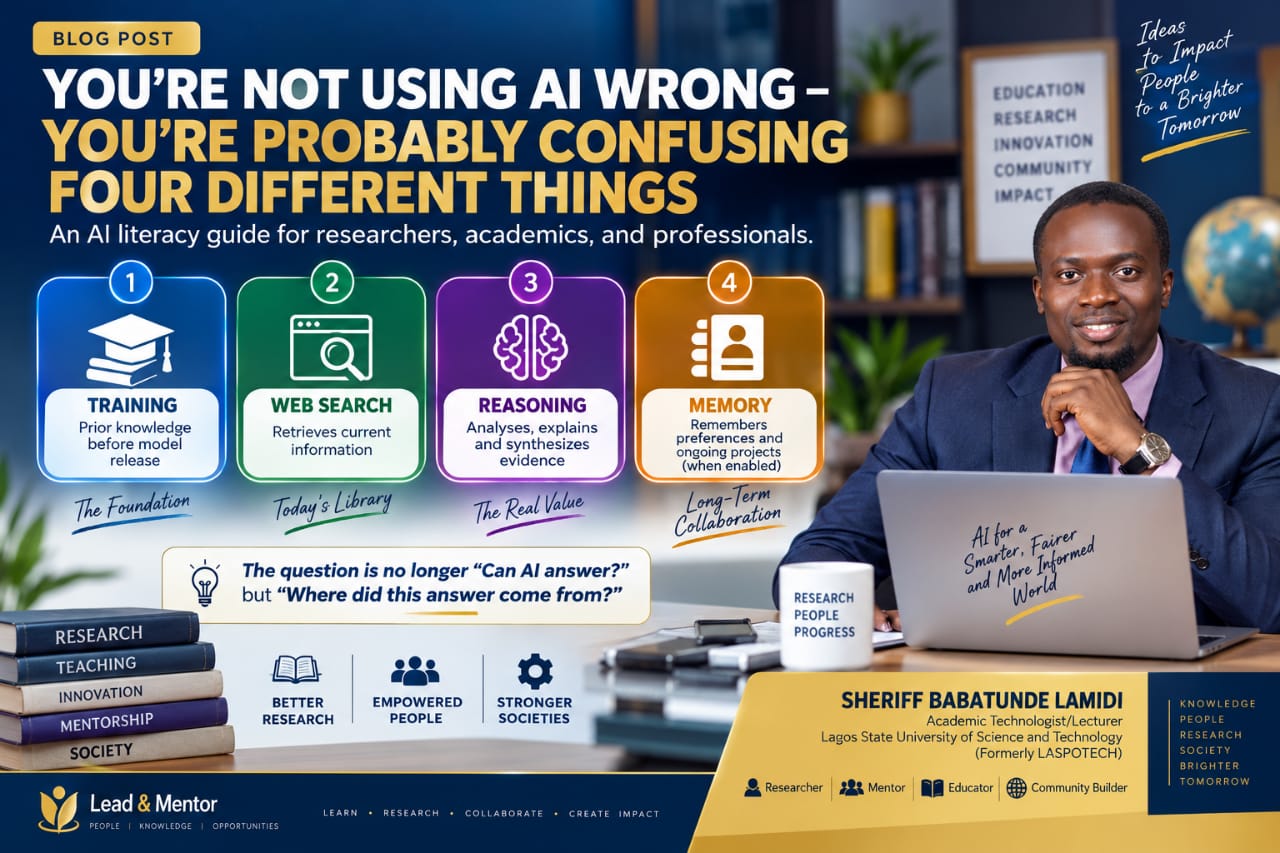
An AI literacy guide for researchers, academics, and professionals.
A recent conversation made me realize that many intelligent professionals including researchers ask the wrong question about ChatGPT. Instead of asking, “Is ChatGPT intelligent?” a better question is:
“Where does each answer actually come from?”
The answer matters.
If you’re writing research papers, reviewing literature, making business decisions, or using AI in your daily work, understanding this distinction can make you a more effective and more critical AI user. The four concepts people often confuse are training, reasoning, web search, and memory.
The Four Layers Behind an AI Response
Think of ChatGPT as a researcher working in a university.
It has prior education, access to today’s information when needed, the ability to analyze evidence, and notes about ongoing collaborations.
Those are four different things.
- Training: The Prior Education
Training is the foundation. It consists of knowledge learned before the model is released. This is similar to a researcher’s education before entering today’s seminar. The important point is that training does not update every time someone has a conversation with ChatGPT. A new model release is what updates that foundational knowledge.
- Web Search: Today’s Library Visit
This is where many people become confused. When ChatGPT searches the web, it is not replacing its intelligence.
It is retrieving current evidence. Think of it as walking into the library to read today’s journal articles before answering your question. It can then compare sources, identify patterns, explain implications, and distinguish uncertainty from stronger evidence.
The search provides current information. Reasoning turns that information into understanding.
- Reasoning: The Real Value
This is arguably the most important layer. Reasoning is the ability to: compare competing ideas, explain mechanisms, identify assumptions, connect concepts, and synthesize multiple sources into a coherent answer. Without reasoning, web search would simply produce a list of links. The value comes from interpreting evidence not merely collecting it.
- Memory: The Long-Term Collaboration
If you’ve worked with ChatGPT for months, it may feel like it “knows you. “In reality, this continuity comes from memory features and conversation context not from retraining the model on your identity. For example, it may remember your preferred writing style or an ongoing project, allowing future conversations to begin with useful context.
That’s collaboration not instant retraining.
The Most Common Misconception
Many people assume:
“If ChatGPT reads something today, it becomes permanently smarter tomorrow.”
That’s not how it works.
Instead:
Today’s conversation improves today’s answer. Memory improves future conversations with the same user (when enabled).
Training improves future versions of the model after OpenAI develops and releases them. Those are three different mechanisms.
Why Researchers Should Care
As academics, we’re trained to ask more than “what.”
We ask.
How do we know this?
What is the evidence?
What assumptions are hidden?
Where did this conclusion originate?
Those same questions should guide how we use AI. When AI becomes a research assistant rather than an unquestioned authority, it becomes significantly more valuable. Use it to: clarify concepts, compare theories, draft and refine writing, analyse evidence and accelerate knowledge work. But always distinguish between established knowledge, retrieved evidence, and interpretation.
A Practical Mental Model
Think of ChatGPT as a researcher with four capabilities:
- Capability-Human Analogy
- Training-Prior education
- Web Search- Reading today’s literature
- Reasoning-Critical analysis
- Memory- Long-term collaboration
Understanding these distinctions helps you use AI more effectively and more responsibly. The goal isn’t to outsource thinking. It’s to strengthen it.
Final Thought
AI literacy is becoming as important as digital literacy once was. The professionals who gain the greatest advantage won’t necessarily be those who use AI the most. They’ll be those who understand how it produces knowledge and when to question it.
That’s a research mindset worth keeping.